Manufacturing industries continuously adopt new technologies to improve precision, efficiency, and productivity. Two commonly discussed technologies in material processing are hybrid machines and laser machines. Both systems are designed to enhance manufacturing performance, but they differ significantly in working technology, accuracy, speed, and application areas.
Understanding the difference between hybrid vs laser machine technology is essential for manufacturers, fabricators, and engineering industries that want to choose the most suitable equipment for their production processes. This guide explains how these machines work, their advantages, and when each technology should be used.
What Is a Hybrid Machine?
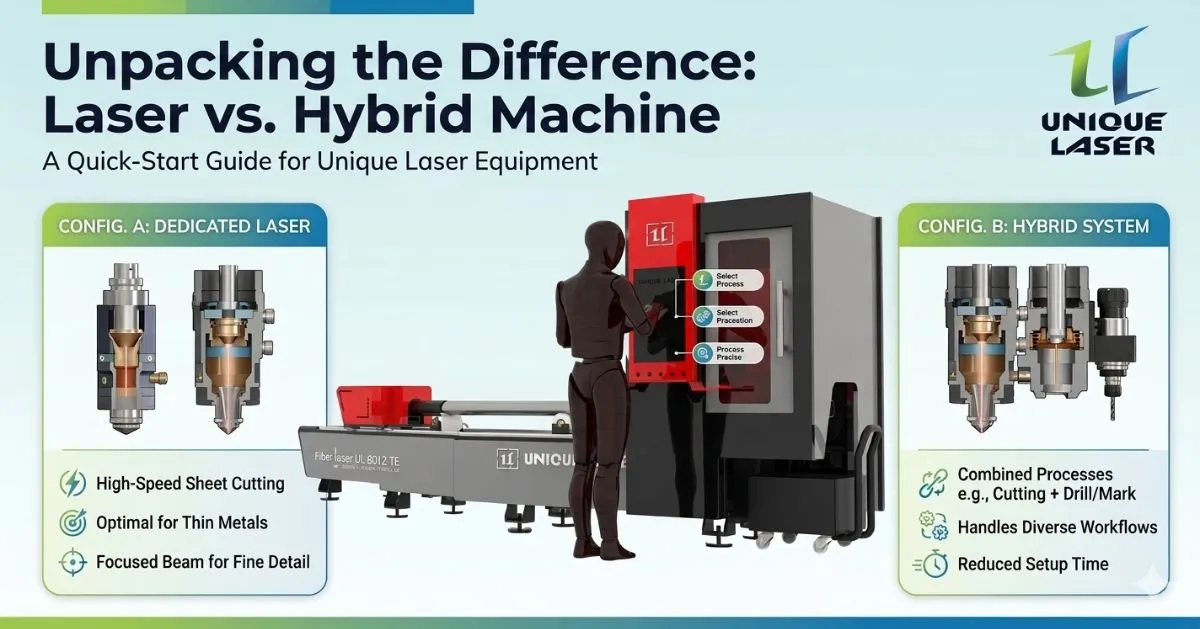
A hybrid machine combines two or more manufacturing technologies into a single system. In industrial fabrication, hybrid machines commonly integrate mechanical cutting methods such as punching or milling with laser cutting technology.
The goal of hybrid machines is to provide multiple processing capabilities in one machine, allowing manufacturers to perform different operations without moving the material to separate machines.
Key Features of Hybrid Machines
- Combines mechanical cutting and laser processing
- Supports multiple manufacturing operations
- Reduces the need for multiple machines
- Suitable for complex fabrication processes
- Improves workflow efficiency in certain applications
Hybrid systems are widely used in sheet metal fabrication and complex part manufacturing where multiple machining steps are required.
What Is a Laser Machine?
A laser machine uses a concentrated beam of light to cut, weld, engrave, or mark materials with extreme precision. These machines rely on fiber laser or CO₂ laser technology to process materials without direct mechanical contact.
Laser machines are widely used in industries that require high accuracy, clean finishes, and fast processing speeds.
Key Features of Laser Machines
- Uses high-powered laser beam technology
- Provides high precision cutting and marking
- Minimal heat-affected zones
- High-speed production capability
- Low maintenance compared to traditional machines
Laser machines are commonly used for laser cutting, laser welding, laser marking, laser engraving, and laser cleaning in modern industrial manufacturing.
Difference Between Hybrid vs Laser Machine
| Feature | Hybrid Machine | Laser Machine |
| Technology | Combines multiple machining technologies | Uses focused laser beam for processing |
| Processing Method | Mechanical + Laser | Pure laser processing |
| Precision | Moderate to high | Extremely high precision |
| Speed | Moderate | High-speed production |
| Maintenance | Higher due to multiple components | Lower maintenance |
| Applications | Complex multi-process fabrication | High-precision cutting, welding, marking |
| Flexibility | Multiple operations in one machine | Specialized laser processing |
Advantages of Hybrid Machines
Hybrid machines offer several benefits for manufacturing environments where multiple operations are required.
1. Multi-Process Capability
Hybrid machines combine different manufacturing processes, reducing the need for multiple machines in a production line.
2. Improved Workflow
By integrating different processes into one system, hybrid machines reduce handling time and improve workflow efficiency.
3. Cost Savings for Complex Manufacturing
For operations requiring punching, drilling, and cutting together, hybrid machines can reduce overall production costs.
Advantages of Laser Machines
Laser machines have become the preferred technology in many industries due to their precision and speed.
1. High Precision
Laser machines can cut and mark materials with extremely fine accuracy, making them ideal for automotive, aerospace, and electronics manufacturing.
2. Faster Production
Laser cutting machines operate at high speeds, allowing manufacturers to increase production output.
3. Minimal Material Waste
Laser technology creates clean edges and precise cuts, reducing scrap material.
4. Low Maintenance
Since laser machines are non-contact tools, there is minimal wear on components compared to mechanical cutting tools.
5. Automation Compatibility
Laser systems can easily integrate with robotic and automated manufacturing systems, making them suitable for Industry 4.0 production environments.
Looking for advanced laser machine solutions for your manufacturing needs? Contact us to choose the right laser cutting, welding, and marking machines for efficient industrial production.
Applications of Hybrid vs Laser Machines
Hybrid Machine Applications
- Sheet metal fabrication
- Automotive component manufacturing
- Industrial equipment production
- Multi-process metal fabrication
Laser Machine Applications
- Metal cutting and fabrication
- Laser welding in automotive industries
- Product identification and traceability
- Laser engraving and marking
- Precision component manufacturing
Which Machine Is Better for Manufacturing?
The choice between hybrid vs laser machine technology depends on the production requirements of a business.
- If a manufacturing process requires multiple machining operations in one setup, a hybrid machine may be beneficial.
- If the focus is on high-speed precision cutting, welding, or marking, laser machines provide better performance and efficiency.
Today, many industries prefer fiber laser machines due to their speed, accuracy, and energy efficiency, making them ideal for modern manufacturing environments.
Future of Laser Technology in Manufacturing
The global manufacturing industry is increasingly adopting fiber laser technology due to its superior performance compared to traditional processing methods. Advances in automation, robotics integration, and AI-driven manufacturing systems are further enhancing laser machine capabilities.
Laser technology is expected to play a major role in smart factories and Industry 4.0 manufacturing systems, enabling businesses to improve productivity and maintain consistent product quality.
Frequently Asked Questions
Hybrid machines combine multiple machining processes, while laser machines use a focused laser beam for high-precision cutting, welding, and marking.
Yes, laser machines generally offer higher precision and cleaner cuts compared to hybrid systems.
Laser machines are widely used in automotive, aerospace, electronics, engineering, medical device manufacturing, and metal fabrication industries.
Fiber laser machines are highly energy efficient and consume significantly less power compared to traditional cutting technologies.
Conclusion
Both hybrid machines and laser machines play important roles in industrial manufacturing. Hybrid machines provide flexibility by combining multiple processes, while laser machines deliver unmatched precision, speed, and efficiency.
For industries focused on high-quality metal processing, precise cutting, and automated production, laser machines often offer the most advanced and reliable solution.
Understanding the difference between hybrid vs laser machine technology helps manufacturers select the right equipment for their production needs and remain competitive in modern industrial markets.