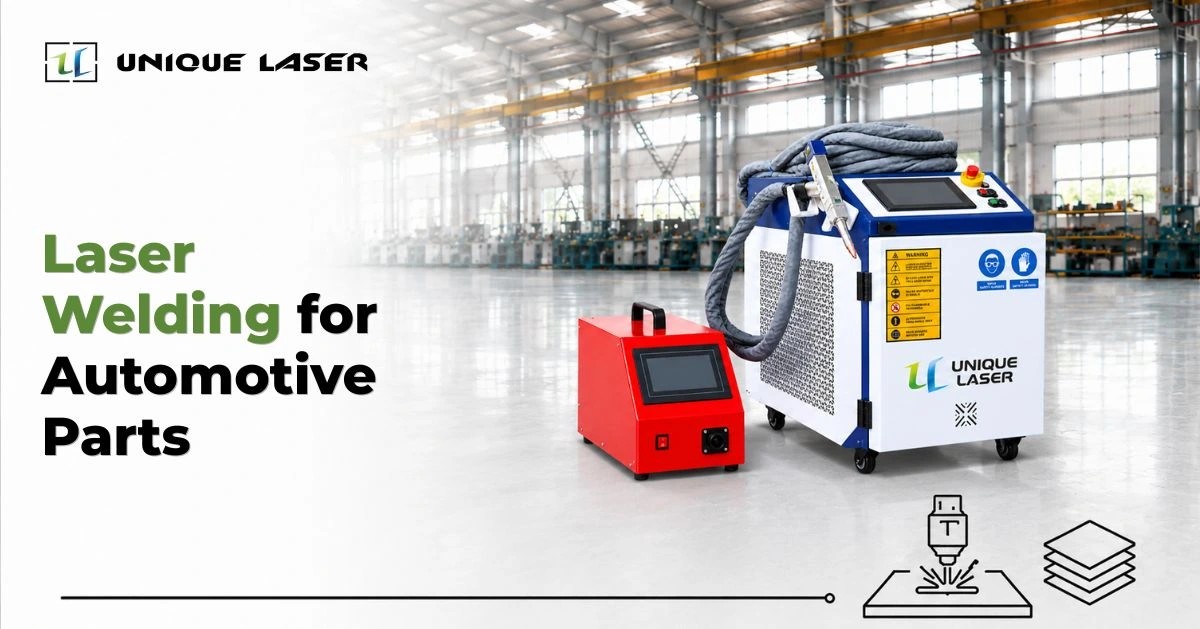
Automotive manufacturing requires joining processes that deliver strength, dimensional consistency, repeatability, and efficient production. As vehicle designs become more lightweight and electrically driven, manufacturers increasingly work with complex metal components and assemblies. In these applications, a Laser Welding Machine can provide a focused and controlled heat source for producing precise welds with limited thermal influence on surrounding areas.
Why Is Laser Welding Used for Automotive Parts?
Automotive components often require accurate joints and consistent weld quality across large production volumes. Traditional welding methods can introduce more heat into the surrounding material, which may contribute to distortion or require additional finishing in certain applications.
With automotive Laser Welding Machine, the concentrated laser beam directs energy precisely toward the joint. This allows manufacturers to control the welding zone and create repeatable welds according to programmed paths. The process can be particularly useful where component geometry, appearance, dimensional accuracy, or production speed is important.
Which Automotive Parts Can Be Laser Welded?
Laser welding can be used for a variety of automotive components, provided the material, thickness, joint design, and accessibility are suitable. Applications can include:
- Body panels and sheet-metal assemblies
- Structural and reinforcement components
- Brackets and mounting components
- Housings and enclosures
- Exhaust-related components
- Electrical connectors and assemblies
- Sensors and precision components
- Battery components and connections
- Lightweight aluminium assemblies
For manufacturers considering laser welding for automotive components, the welding method should be selected according to the component design and required joint characteristics rather than using the same configuration for every application.
Laser Welding for Electric Vehicle Components
The growth of electric vehicles has introduced additional welding requirements for battery and electrical assemblies. Battery tabs, terminals, busbars, housings, and other conductive connections can require controlled and repeatable joining.
A Fiber laser welding can be useful for suitable EV applications because its concentrated energy can create localized welds. Aluminium and copper, however, have particular thermal and reflective characteristics, so the laser power, welding speed, focus, and other process parameters must be matched carefully to the application.
Looking for a reliable Laser Welding Machine for automotive applications? Contact Us for precise, efficient, and consistent welding solutions.
Benefits of Laser Welding in Automotive Manufacturing
When correctly configured, laser technology can provide several advantages for automotive production. The main benefits include:
- Precise and localized heat input
- High weld repeatability
- Fast processing capability
- Reduced potential for thermal distortion
- Consistent programmable welding paths
- Compatibility with automated production
- Ability to process small or detailed weld areas
- Reduced mechanical contact with components
These characteristics make precision Laser Welding Machine suitable for automotive applications where consistent production quality and controlled welding performance are important.
How Automation Improves Automotive Laser Welding?
Automotive manufacturing frequently involves repetitive production operations where consistency is essential. Laser welding systems can be integrated with robotic equipment, CNC systems, positioning systems, and other automated production technologies.
Using industrial Laser Welding Machine within an automated line can help maintain programmed welding paths and consistent process parameters across repeated components. Automation can also support faster production cycles while reducing variation associated with manual positioning.
However, automation alone does not guarantee weld quality. The machine configuration, component positioning, joint preparation, laser parameters, and overall process design must work together for reliable production.
What Should Manufacturers Consider When Choosing a Laser Welding Machine?
The appropriate equipment depends on the specific automotive application. Manufacturers should evaluate material type, material thickness, component dimensions, joint configuration, required welding speed, production volume, and accessibility before selecting a system.
For a laser welding machine for automotive applications, other considerations include laser power, working area, cooling requirements, software and control systems, automation compatibility, maintenance requirements, operator training, and technical support.
Manufacturers should also consider whether the machine can accommodate future production requirements. Testing actual automotive components and joint configurations before purchasing equipment can provide useful information about welding performance and process suitability.
Why Process Parameters Matter?
Consistent results depend on more than machine power. Laser focus, welding speed, beam positioning, power settings, material properties, joint preparation, and component tolerances can all influence the final weld.
For automotive component welding, optimizing these parameters helps manufacturers achieve the required penetration and weld appearance while controlling heat input. Process development should therefore be carried out according to the specific material and component rather than relying on generic settings.
Frequently Asked Questions
Yes. Laser welding can be used for suitable automotive body, structural, electrical, battery, exhaust, and precision components, depending on material and joint requirements.
It can be suitable for various EV applications, including battery components, terminals, busbars, and electrical connections when the process is properly configured.
Depending on the machine and application, automotive laser welding can be used with materials such as steel, stainless steel, aluminium, copper, and other suitable metal alloys.
Yes. Laser welding systems can be integrated with robotic equipment, CNC systems, automated positioning systems, and production lines for repeatable manufacturing.
Material type, thickness, joint design, laser power, welding speed, focus, component preparation, positioning accuracy, and process parameters can all affect weld quality.
Conclusion
Automotive manufacturers need joining technologies that can support precision, repeatability, production efficiency, and increasingly complex component designs. A properly configured Laser Welding Machine can support applications ranging from body and structural components to EV battery and electrical assemblies. By evaluating material requirements, joint design, automation, production volume, and process parameters, manufacturers can determine whether laser welding is suitable for their specific automotive production needs.