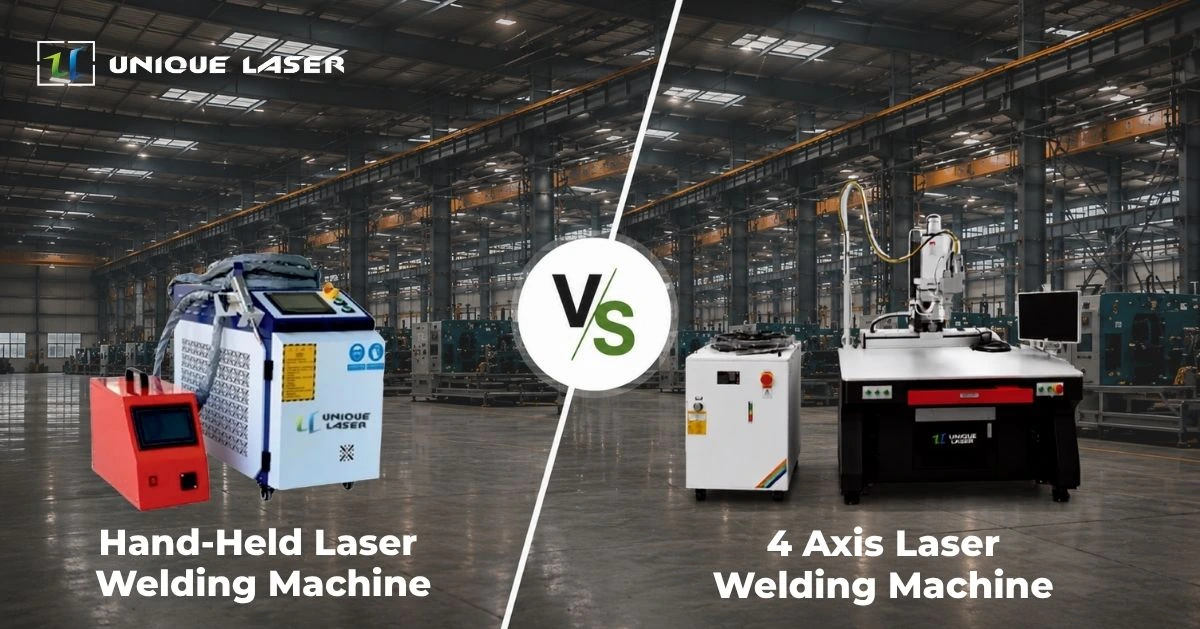
Choosing the right laser welding solution is an important decision for manufacturers aiming to improve weld quality, production efficiency, and long-term operational performance. While a Handheld Laser Welding Machine offers flexibility for custom fabrication and repair work, a 4 Axis Laser Welding Machine is designed for automated, high-volume production with exceptional repeatability. Understanding the differences between these two systems helps manufacturers select the most suitable solution for their applications.
What Is a Handheld Laser Welding Machine?
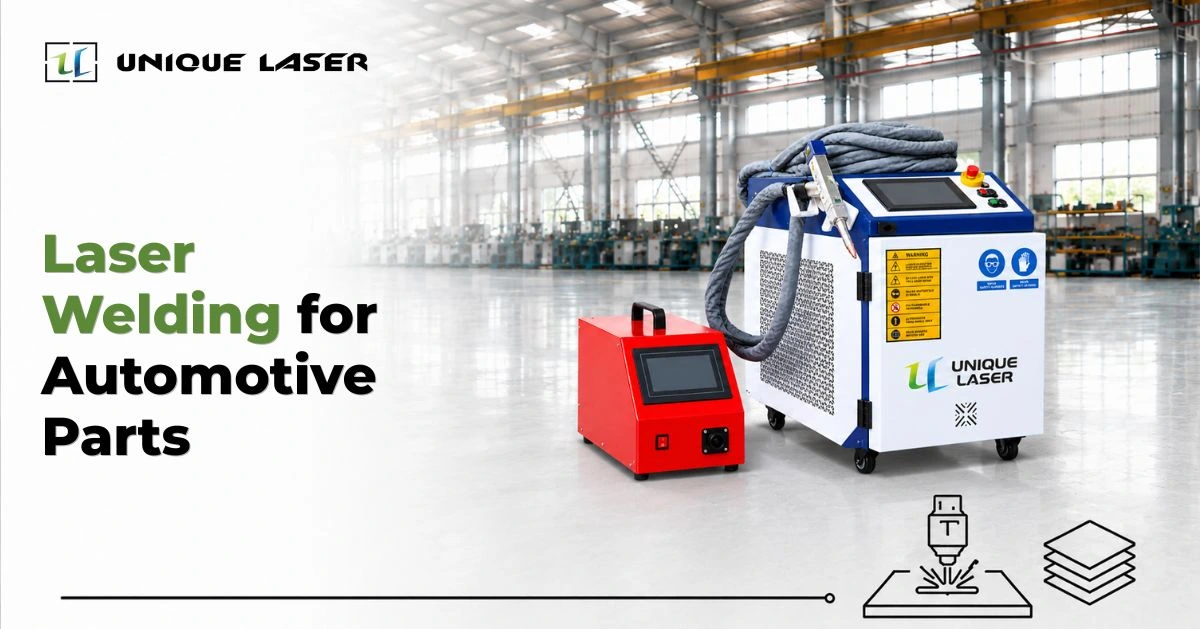
A Handheld Laser Welding Machine is a portable welding system that allows operators to perform precise welding on large, irregular, or difficult-to-access components. Its flexible welding gun, red light positioning, and deep weld penetration make it ideal for workshops, stainless steel fabrication, maintenance work, and custom manufacturing.
Typical applications include:
- Stainless steel fabrication
- Kitchen equipment
- Railings and guardrails
- Metal furniture
- Distribution boxes
- Repair and maintenance work
What Is a 4 Axis Laser Welding Machine?
A 4 Axis Laser Welding Machine is an automated laser welding system designed for repetitive, high-precision welding operations. Using an electric translation stage and programmable motion control, it delivers consistent weld quality, high repeatability, and excellent productivity for industrial manufacturing.
Typical applications include:
- Automotive components
- Engineering equipment
- Electrical enclosures
- Sheet metal fabrication
- Industrial machinery
- Precision manufacturing
Handheld vs 4 Axis Laser Welding Machine
| Feature | Handheld Laser Welding Machine | 4 Axis Laser Welding Machine |
| Operation | Manual, operator-controlled | Automated and programmable |
| Best For | Custom fabrication and repair | High-volume production |
| Flexibility | Excellent | Moderate |
| Repeatability | Operator dependent | High repeat accuracy |
| Welding Paths | Manual, continuous and spot welding | Straight lines, circles, arcs, spot, continuous, programmable paths |
| Positioning | Red light positioning | CCD or Red Light |
| Production Speed | Fast | Very high |
| Material Deformation | Minimal | Minimal |
| Laser Power | 1500W, 2000W, 3000W, 6000W | 1500W, 2000W, 3000W |
Which Machine Is Better for Your Production?
The right choice depends on production requirements rather than simply selecting the most advanced machine.
Choose a Handheld Laser Welding Machine if you need:
- Flexible welding for different component sizes
- Easy access to complex weld joints
- Portable operation
- Repair and maintenance capabilities
- Low to medium production volumes
Choose a 4 Axis Laser Welding Machine if you need:
- Automated production
- High repeatability
- Continuous manufacturing
- Programmable welding paths
- High-volume industrial output
Looking for the right laser welding solution for your manufacturing needs? Contact Us today to explore advanced Handheld Laser Welding Machine and 4 Axis Laser Welding Machine solutions designed for reliable industrial performance.
Key Factors to Consider Before Buying
Before investing in either system, manufacturers should evaluate:
- Daily production volume
- Component size and complexity
- Material type and thickness
- Required welding accuracy
- Available workspace
- Automation requirements
- Future production expansion
- Technical support and maintenance
Evaluating these factors helps ensure the selected welding system aligns with current operations and future manufacturing goals.
Advantages of Each Machine
Advantages of Handheld Laser Welding Machine
- Portable and easy to operate
- Ideal for custom fabrication
- Deep weld penetration
- Minimal heat distortion
- Reduced post-processing
- Suitable for complex welding applications
Advantages of 4 Axis Laser Welding Machine
- Automated and programmable
- High positioning accuracy
- Excellent repeatability
- Faster production cycles
- Consistent weld quality
- Ideal for precision manufacturing
Frequently Asked Questions
A Handheld Laser Welding Machine is designed for flexible manual welding, while a 4 Axis Laser Welding Machine is built for automated, repeatable, and high-volume industrial production.
A Handheld Laser Welding Machine is better suited for custom fabrication because it provides greater flexibility when welding large or irregular components.
Yes. Its programmable motion system and high repeatability make it ideal for continuous industrial manufacturing.
Automotive, engineering, sheet metal fabrication, electrical manufacturing, stainless steel fabrication, machinery manufacturing, and industrial equipment production all benefit from these systems.
Yes. Both machines deliver deep weld penetration, clean weld seams, and minimal heat distortion when configured correctly.
Conclusion
Production requirements, application complexity, and automation goals should guide the selection between a Handheld Laser Welding Machine and a 4 Axis Laser Welding Machine. Manufacturers handling custom fabrication and repair work benefit from the portability and flexibility of handheld systems, while automated production environments gain greater efficiency from programmable multi-axis welding. Choosing the right solution helps improve weld quality, increase productivity, reduce post-processing, and support long-term manufacturing performance.