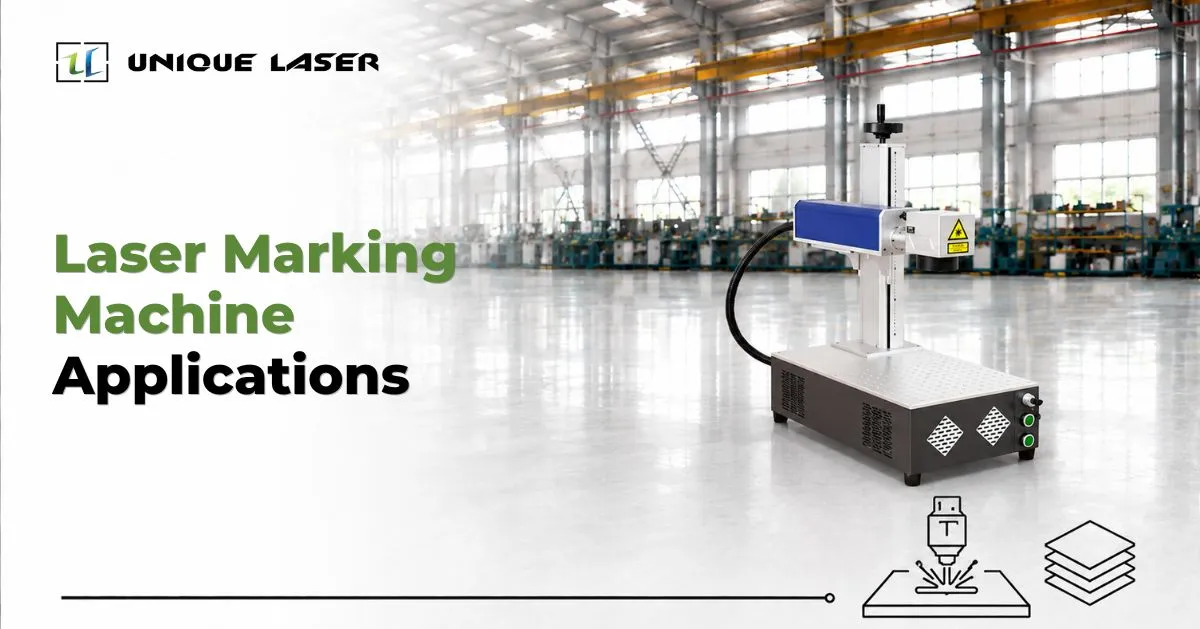
Modern manufacturers need product identification that remains clear throughout production, handling, assembly, and service. A Laser Marking Machine creates permanent marks directly on suitable surfaces, including serial numbers, QR codes, barcodes, logos, batch numbers, and date codes. Its precision and digital control make it useful across industries where accurate identification and traceability are important.
Key Applications of Laser Marking Machines
A Laser Marking Machine is used across various industries where permanent, precise, and readable identification is required. From automotive and electronics to medical devices, engineering components, jewelry, tools, and industrial products, laser marking technology helps manufacturers apply serial numbers, codes, logos, and traceability information directly to suitable surfaces. Its non-contact operation, digital control, and repeatable marking quality make it suitable for both individual components and high-volume production environments.
Automotive Components
Automotive manufacturers use industrial laser marking to identify components with serial numbers, part numbers, production codes, and traceability information. Engine components, brackets, shafts, gears, and other metal parts can require permanent identification that remains readable during handling and operation.
Direct marking eliminates dependence on separate labels for suitable applications and helps manufacturers associate identification information with individual components throughout their production lifecycle.
Electronics and Electrical Components
Electronic and electrical products often contain small surfaces where conventional labels may be difficult to apply. A fiber laser marking machine can create precise text, symbols, product codes, and identification marks on suitable components.
Applications can include connectors, terminals, electrical enclosures, switches, and other manufactured parts. Computer-controlled marking allows manufacturers to reproduce detailed designs consistently across production batches.
Medical Devices and Instruments
Medical equipment and instruments can require durable identification for product tracking and manufacturing records. Permanent laser marking can be used on suitable materials to create identification numbers, codes, logos, and other required information.
Because the process is non-contact, manufacturers can produce detailed markings without mechanically contacting the component during the marking operation. The exact marking method should be selected according to the material and applicable product requirements.
Engineering and Machinery Parts
Industrial machinery contains numerous components that may need identification during manufacturing, assembly, maintenance, and service. Laser marking technology can mark machine parts, tools, shafts, gears, housings, and other suitable components with serial numbers, specifications, logos, or production information.
Permanent identification can make individual parts easier to recognize during inspection and maintenance while supporting organized production records.
Jewelry and Decorative Products
Laser marking is also suitable for applications requiring fine and detailed markings. Jewelry manufacturers can use a precision laser marking system for names, logos, symbols, patterns, identification numbers, and customized designs on suitable products.
The digital nature of the process makes it easier to change designs between products without requiring physical marking dies or dedicated mechanical tooling.
Industrial Product Traceability
Traceability is an important application of product identification marking in modern manufacturing. Serial numbers, QR codes, barcodes, batch numbers, and other identifiers can connect physical products with production information.
Manufacturers can use these marks to support component identification, inspection records, batch tracking, inventory processes, and after-sales service. This becomes particularly useful when products move through multiple stages of manufacturing and distribution.
Tools and Hardware
Tools, fasteners, hardware, and industrial equipment may require permanent identification for branding, specifications, part numbers, or tracking. A laser marking system can create consistent marks on suitable metal surfaces without requiring direct mechanical contact.
For manufacturers producing large quantities of similar components, programmable marking can help maintain consistency while allowing different identification details to be applied to individual products or batches.
Packaging and Product Identification
Certain packaging and product surfaces can also require direct marking of manufacturing information. Industrial product marking can be used for suitable applications involving batch codes, date information, identification numbers, and other variable data.
Digital control allows marking information to be changed according to the production batch, helping manufacturers maintain accurate product identification without changing physical tooling.
Looking for a reliable Laser Marking Machine? Contact Us for precise and efficient marking solutions for industrial applications.
Why Choose Laser Marking for These Applications?
Across these industries, a Laser Marking Machine can provide several practical advantages:
- Permanent and durable identification
- High marking precision
- Non-contact processing
- Fast and repeatable operation
- Minimal consumables
- Digital marking control
- Ability to mark detailed designs
- Suitable for automated production environments
The appropriate laser source, power, marking speed, lens configuration, and process parameters depend on the material and application.
How to Select the Right Machine?
Manufacturers should first identify the material, marking area, required marking depth or contrast, production volume, and type of information to be marked. A fiber laser marking machine may be suitable for many metal-marking requirements, while other materials may require a different laser configuration.
Working area, marking speed, software compatibility, automation requirements, maintenance, and technical support should also be considered before selecting equipment.
Frequently Asked Questions
Common applications include automotive components, electronics, medical devices, engineering parts, jewelry, tools, hardware, and product traceability.
Yes. Serial numbers, QR codes, barcodes, batch numbers, and other identifiers can be permanently marked on suitable products and components.
Material compatibility depends on the laser source and machine configuration. Fiber laser systems are commonly used for many metal-marking applications.
Yes. The focused laser beam and computer-controlled movement can produce detailed markings on suitable small components.
Yes. Suitable systems can be integrated with automated manufacturing equipment for consistent, repeatable marking operations.
Conclusion
From automotive and electrical components to medical devices, engineering parts, jewelry, tools, and traceability systems, a Laser Marking Machine can support a wide range of industrial identification requirements. Selecting the right machine configuration according to material, marking requirements, production volume, and automation needs helps manufacturers achieve consistent and durable marking results.